I was very fortunate to attend an interesting, informative, and reflective research seminar, Reflection on How AI Forms Bias and What Educators Can Do About It, on 12 January 2026. The highlight of the seminar was the keynote speaker, Kieran Gilmurray, a globally recognized authority on AI, digital transformation, and data-driven business. What impressed me most was how he opened my eyes to the new “intelligent skills” that will be needed by 2030.
The workshop was designed for educators. I am not an educator; I am a PhD researcher and a healthcare professional. My role is also a Research Assistant for this AI in Education project. Thus, I realized that I am still part of this change and its impact. Have I prepared myself for this new era? I have been using AI for less than two years and feel fairly confident in using it responsibly, considering environmental costs. At the same time, I worry that I am behind other users and am concerned about AI’s impacts on mental health.
Here are ten skills required by 2030, according to Kieran Gilmurray.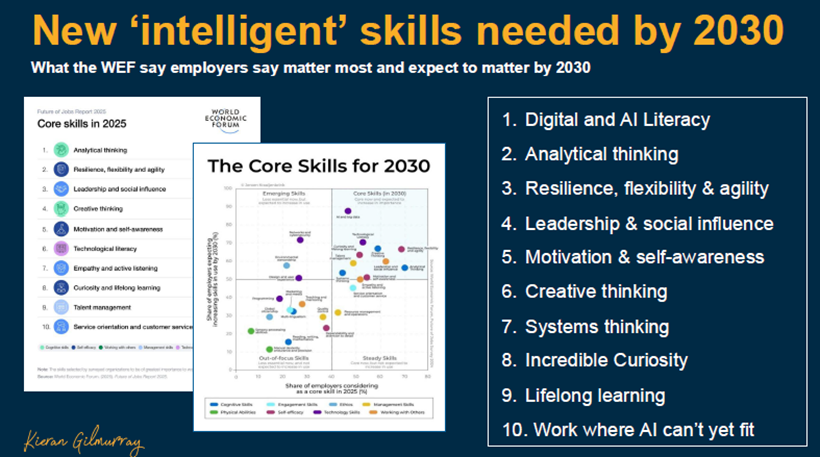
(Source: Kieran Gilmurray)
Honestly, I am not worried that AI will replace me or my job in the near future, as I am learning to take advantage of AI to enhance my work and performance. I use AI as a tool, not as a friend or advisor.
When the seminar discussed “How AI Learns and Where Bias Enters” (Section 3) and “Risks for Educators and Students” (Section 5), I strongly agreed with the points presented. I noticed skewed answers in ChatGPT and Gemini every single time I critically evaluated AI outputs. AI systems always seem to try to please me. From the perspective of an adult learner, I share Gilmurray’s concerns about the risk of eroding critical thinking. I am also concerned about fairness in student assessment. These issues arise due to flawed AI detection engines and varying university policies on AI use. I am less worried about fairness within a single university, but I am concerned about differences between universities and whether I might fall behind due to these variations.
The aspect of hallucinations is what I dislike most about AI. The line between reality and AI-generated content is very thin. Furthermore, the overload of fake news on social media, especially YouTube, has surged because of AI. Students and children are constantly exposed to targeted fake videos and images designed purely for views and likes. I imagine a future in which AI develops so much that people cannot distinguish between real and fake outputs. Can we still control it? I have failed to detect AI-generated fake news many times myself, so what about our students who are still in school?
These concerns should be included in the agenda for AI regulation at both global and national levels. I support the use and development of AI, but it must be done responsibly and within a framework of strong regulations. Educators should raise greater awareness of AI’s impact on mental health and wellbeing, not just on academic performance or fairness in education. This should also work with parents and caregivers, who may be behind in this era, to protect our future generation.
Luong Tran,
Role: Research Assistant
Project: AI in Education in Vietnam
Affliation: Birmingham City University