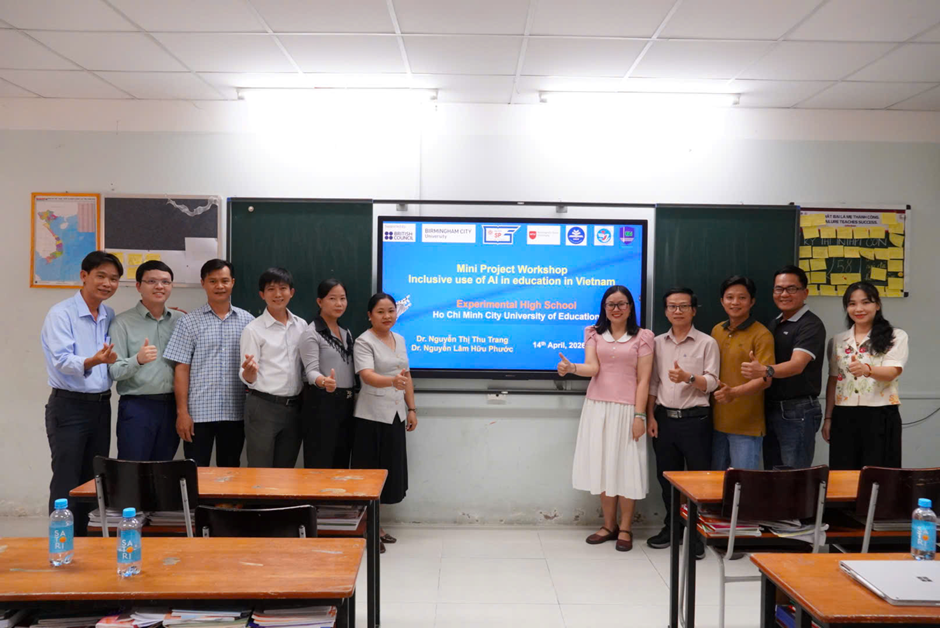
As part of an interdisciplinary initiative supporting digital transformation in education across diverse geographic regions and gender groups in Vietnam, in April 2026, teacher educators from four partner universities in Vietnam delivered the training programme “Integrating AI in Education: Phase 2 (Mini-Projects)”. Building on research findings and the initial training in Phase 1 led by experts in 2025 (26 August 2025, 17 August 2025), this phase focuses on the transition from knowledge to practice through teacher–expert co-creation of AI-supported teaching resources in real educational contexts.
The Phase 2 activities specifically engaged high-school teachers from STEM, English, Literature, History, and Experimental High School settings from North, Central, and South Vietnam.
Teacher–expert co-creation approach
The mini-projects are built on collaboration between teachers and project experts. Each project typically involves 02 teachers from the same school who will develop and implement a mini project on developing a teaching plan with AI assistance, based on previous training and experiences.
Objectives: (1) To compare and improve lesson plans through collaborative review and reflection, and (2) To enhance teaching and learning design and delivery with AI assistance.
The co-creation process positioned teachers not as passive recipients of training, but as active designers of AI-integrated pedagogical solutions.
Engagement across the project cycle
Teacher engagement was structured across three stages:
Before training, participants completed a survey to identify initial challenges in using AI, assess current levels of integration, and highlight areas requiring further support. This helped establish a baseline understanding of needs across different contexts. Two teachers from each high school created a mini-project on teaching plans with AI assistance.
During training, pairs of teachers presented a prepared plan to gain feedback from experts and fellow trainees.
After training, participants will refine lesson plans to ensure they are effective and relevant to classroom practice. These plans, referred to as co-created materials, will be shared across teacher cohorts and uploaded to an online platform for wider access. A post-training survey will also be completed to reflect changes in practice.
Implementation across institutions
Phase 2 activities were implemented across multiple institutions, including:
- Ho Chi Minh City University of Education (HCMUE): delivers co-creation training with partnering schools, including Experimental High School in HCM and Chau Phu High School in An Giang province (South);
- Vietnam National University (VNU) – University of Education: provides training for partner high schools in Hanoi (North), including High School of Education Sciences and Phan Huy Chu High School;
- Vinh University: delivers training for partner high schools in Nghe An province (Central), including Quy Chau High School and Que Phong High School;
- Hanoi University of Education (HNUE): University of Education: provides training for Yen Khanh A High School in Ninh Binh (North);
Teachers’ engagement highlights
The engagement of high school teachers is highlighted as follows:
- High levels of participation in hands-on tasks and co-creation activities
- Active collaboration between teachers within schools and across institutions
- Strong willingness to experiment with AI tools in real teaching contexts
- Increased dialogue between educators and experts during the design and reflection stages
Teachers reflected significant shifts in confidence, particularly in using AI for lesson design and assessment development.
AI integrating in teaching highlights
- Development of AI-enhanced lesson plans and teaching materials
- Initial classroom experimentation with AI-supported activities
- Increased teacher confidence in integrating AI into pedagogy
- Strengthened professional collaboration between schools and universities
Information and images from training activities are available ob
Upcoming activities
Finalising teacher–expert co-created resources and making them available on the project website.
To learn more about engagement activities with our partner high schools, please visit the project website at Project networks and impact.
By Luong Tran, PhD Candidate, Project Assistant, Birmingham City University